

Most teams know warm intros convert better than cold outreach, but very few run them as a channel. In this LinkedIn Live, Josh Carter, Head of RevOps at 1mind, walks Shankar Ganapathy through how 1mind turned relationships into a weekly pipeline source, which connectors to load, and how reps use the Boomerang MCP in Claude to find and activate warm paths.
Josh Carter, Head of RevOps, 1mind. Josh runs revenue operations at 1mind, which builds AI go to market superhumans for enterprise tech companies. He previously led demand gen and RevOps at Pavilion, where he teaches Clay in the AI in go to market courses.
Shankar Ganapathy, Co-founder, Boomerang AI. Shankar co-founded Boomerang AI, which helps B2B revenue teams turn relationships into introductions and revenue. Before Boomerang he sold enterprise sales enablement software.
Read the full story: How 1mind turned relationships into record pipeline weeks. See how Boomerang works and compare plans and pricing.
Try Boomerang for free or book a demo with Shankar.
Shankar: I'm going to click on go live, Josh. Perfect, I think we are live. Josh, just so you know, there's typically a 20 to 30 second lag between what we say and what the audience hears on LinkedIn Live. I see people starting to trickle in. Hey everyone, welcome. We'll give folks another minute to join. While they do, drop a quick hello in the chat: where you're coming from and what you do. I'd love to know who's in the room so we can tailor the content.
Josh: Good to see everybody. We've got a good group of folks in the room. Hey John, how are you doing? I'm scared to open up the LinkedIn Live tab, because the audio delay is about 20 seconds and it would be very trippy.
Shankar: I was literally troubleshooting that. I was getting double audio, one live and one 30 seconds late in the background, and I had to go find and mute that tab. All good. I think we can get started.
Hey everyone, my name is Shankar. I'm one of the co-founders of Boomerang. We help B2B revenue teams turn relationships into introductions and revenue. Here's why we're doing this session. Most teams we talk to are running into the same challenge: the outbound playbook is getting harder and harder. More emails, more dials and more sequences don't mean more pipeline or more revenue. At the same time, market winners like 1mind are taking a very different approach to go to market.
I'm joined by Josh Carter, Head of Revenue Operations at 1mind. He just rolled out a relationship pipeline with Boomerang at 1mind, and over the next 40 or so minutes we'll cover what Josh has gone through over the last few months and some of their success stories. Some housekeeping: if you have questions, drop them in the chat. My co-founder and close friend Shyam is monitoring it, will respond as fast as he can, and will highlight the ones that need Josh's attention. Josh, thanks for being here. Would love for you to introduce yourself, 1mind, and what you're doing there.
Josh: Thanks for having me. Pipe gen is a topic I'm pretty passionate about. I spent most of my career in demand gen marketing and now I'm in a RevOps role at 1mind, and I'm loving it. A lot of my career has been managing SDRs and having revenue responsibility around pipe gen through marketing, so I've been in this mode of figuring out all the hacks and plays: what's working and what's not.
At 1mind we sell go-to-market superhumans. They're AI agents that sit on your website to qualify, demo and book; sit in your product to onboard, guide and upsell users; and join Zoom meetings to provide technical support and produce assets on the fly, essentially like an SE on your call. We work primarily with enterprise tech companies. As we all know, breaking into those accounts is very difficult, and it's harder to run outbound against them than it was five years ago, or even a few years ago, because of all the AI slop outbound people are running. Email fatigue is real.
So when we run outbound at 1mind, we use relationships as a key part of driving pipe gen: either asking for a referral from someone in our network, or name dropping in outbound to create connection points. When you do that, it's personal and real to that person, there's a relevant connection, and they're much more likely to reply. We're seeing good results using Boomerang to surface those paths into accounts, and reps then action them. It's helped us drive record pipeline weeks since we implemented Boomerang. I'm really happy with what Shankar and the team have built: a product that drives pipeline for sellers through motions we already know work.
Everyone watching has relationships, whether through your board, your advisors or your own employees. They all know people. But it gets tricky to figure out how to get into accounts through those relationships when all you can see is mutual connections. You need more to understand the real paths into accounts. What happened for us is a few reps got creative and built their own spreadsheets of paths into accounts, sifting through LinkedIn with Claude to find ways in. It was working for them, but we had no way of scaling it. That's why I was excited to get introduced to Boomerang, and now we're happy customers.
Today I'd like to share our journey: how we look at and prioritize pipe gen, and then how we use Boomerang to get intros and operationalize them. There's a good mix of marketing, sales and RevOps people watching, so hopefully this is relevant to each of you. I'm fired up about doing fewer activities but higher value activities to drive pipeline, because time is money. If you spend hours building a fancy AI outbound email that anchors on pain points, and a lot of our reps were doing that, it doesn't get results. What does get results is a unique perspective, and somebody who can push the person you're trying to reach to reply or take that first meeting because of a mutual relationship.
People buy from people, and people take references from people. It's why networks like Pavilion are so strong. If you're a Pavilion member you can see how many people ask, "Who's got a tool for relationship mapping? Who's got a tool for AI SDR outbound?" People trust those threads more than a ChatGPT answer or a Google search. It used to be called dark social. Now you can take relationships as a signal and use them to get into accounts. Everybody's done this since the dawn of time, "Who do you know who can help me break into this account?", but nobody had systematized it and built a context graph of the people who can connect you, until Boomerang.
Pipe gen is critical, especially for a growth stage company like ours. We raised our Series A last year and, like every Series A company, we have ambitious growth targets. Marketing is doing well for us, but inbound isn't the only source. We have to do outbound, and do it efficiently, because we don't have an army of SDRs. We have 15 AEs sourcing their own opportunities, and we have to make their pipe gen time efficient.
Shankar: Phenomenal intro, Josh. You've been a leading voice in revenue operations for the better part of a decade, and RevOps today looks fundamentally different from ten years ago. What does pipeline generation look like today and beyond? The traditional setup is sequences and power dialers. From a RevOps perspective, how should teams think about pipeline as they go up market into six and seven figure deals? Would you do anything differently?
Josh: My take is unique signals. Signals work for breaking into accounts, so I think the future of efficient outbound is mapping it to a signal. A signal can be, "You've got three paths into this account through these advisors, investors or customer champions." That's a warm account. And they also need your product because of some other signal.
When I started here in December, I began building a signals library in Clay. We look for unique signals that someone would take a meeting or has a pain we can expose. One is active hiring for sales engineers, solutions consultants or solutions architects. I use Clay to scrape job postings weekly across our account universe; if they're hiring SEs, they likely have capacity problems. I map the number of SEs to AEs in an account to see whether AEs are going unsupported on calls. Those accounts are ripe for a superhuman that sits live on calls and provides technical support, and we have customer stories that make the messaging relevant.
A lot of my work is surfacing those signals to reps where they live every day, which is Slack. Everything is stored in Salesforce in a structured way, and I manage the signal infrastructure and deploy it into their workflow, including cadences in Salesloft for specific signals. Even when automated, it's based on something real happening in the account, and it works better than spray and pray. Spray and pray outbound is dead.
I was at the Pavilion GTM conference a couple of weeks ago, and a few companies talked about their success with power dialing. Phone calls are becoming more effective again. I think the future is human connection, through relationships or actually picking up the phone, because with AI everyone is spraying and praying on LinkedIn and email. A unique way in, through a signal or a relationship, helps. Timeliness matters too: if someone writes a LinkedIn post about a pain we solve, that's a signal their account feels it as well.
I always encourage teams to start by taking reps who've successfully sourced outbound pipeline and reverse engineering what they do instinctively. Relationships were one of those things. Our sellers had a spreadsheet of our advisors plus mutual connections, but they had to connect with people on LinkedIn first. It was working but manual, and we had to figure out how to scale it. So the future is higher quality and less volume, or if you do run high volume, everything has to be relevant, with a real reason for outreach.
Shankar: Before Boomerang I sold enterprise sales enablement software, and we used to say great sales behavior needs to be replicated, so it's a training problem: learn what your best sellers do and train everyone else. You're saying it's not a training problem. You can build a playbook that lives in the workflow.
Josh: You'd be surprised how many teams don't have that feedback loop. People aren't talking to sellers enough. I led a RevOps circle at the Pavilion conference and asked how many have regularly scheduled sessions with their high performers to understand what they're doing well. Not many did. Wherever you sit in the organization, understand what the people on the ground are doing to drive pipeline and the right outcomes. Don't just stick to the manager level, a Claude output or a deal coaching tool. Hear the rep's words, understand their process, and work back from that feedback. It's time consuming, but it works.
Shankar: We talk to many RevOps leaders and GTM engineers who use Clay, and the first instinct is, "I'll find a data vendor, pull it into Clay and build my own system." You went through that journey before buying Boomerang. What made you decide a purpose-built solution had its place?
Josh: Let me share my screen. I looked at our pipeline by source. We bucket sources into outbound, nearbound (relationships and referrals), inbound and events. The data showed we qualify far more of our nearbound opportunities. We track stages from meeting booked to qualified evaluation, and nearbound qualifies at a much higher rate than any other source, which leads to a higher overall close rate from meeting booked to closed. Events are second. Human connection is everything; whether it's an event, a relationship or a referral, those are consistently our top sources.
When I decide what to build for the team, I start with where the biggest opportunity is. If I can get more nearbound, that gets us more revenue. So I first scoped it in Clay. I love Clay; I teach AI in go to market for Pavilion, including Clay in the 101 and 201 courses. But I had a really hard time building this relationship map. You have to regularly scrape LinkedIn profiles, find job overlaps, and track activity like likes, comments and recommendations. There's so much more to relationships than mutual connections in Sales Navigator, which is a great V1, and a lot of our sellers used it.
I went down the path of building a data warehouse for this, pulling from Clay and scraping, and realized it would be very hard to build and harder to maintain. On top of the data model, I'd have to maintain a UI the reps use. The moment something didn't load, I'd get yelled at, and I'd be managing a product instead of doing strategic RevOps work like forecasting.
I think someone may have outbounded one of our leaders, but either way we got introduced, and it was an aha moment to instantly see all the paths into our accounts. The decision was rooted in data: we know we close higher with a relationship or referral, and we know we qualify more, so increasing that volume increases revenue. Then it became build or buy, and we chose to buy.
Everybody is trying to vibe code things. We see it at 1mind in our own deals: someone says, "We could probably build this ourselves." You could, but you'd have to manage the context graph, a voice vendor, a face vendor, and all the queries and their structure. Same with what Boomerang does in mapping connections. It's not sustainable unless you have someone whose only job is building and maintaining internal products, and that's not a common role in mid-market or even most enterprise companies.
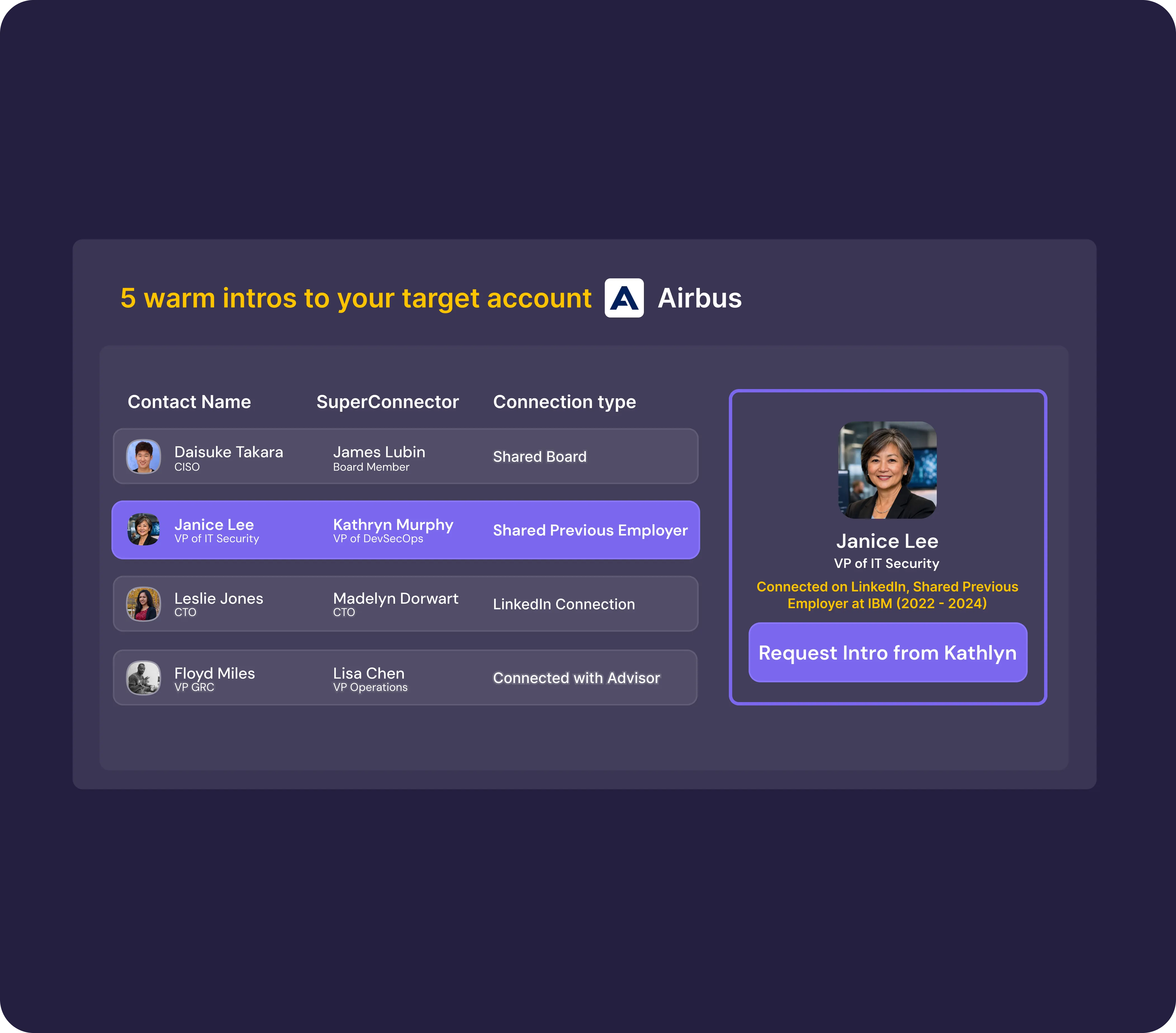
Josh: As a result, after implementing Boomerang, and I've hidden the numbers but they're in the millions of dollars, we've consistently generated more pipeline week over week since we focused in earnest on driving pipeline through relationships and warm referrals. And doing it the right way: not "Hey advisor, I see all these paths into your accounts, help me." Reps take the time to draft a compelling email with a reason for outreach that references the connection. Say an advisor overlapped at IBM with someone we're trying to reach: the rep drafts an email that references that connection point, the reason for outreach and the specific pain we solve for that company. We're arming the connector with a solid perspective on why their contact should take a meeting.
That has led to good adoption by our sellers and to our champions, advisors, investors and internal employees, all connectors in Boomerang, being comfortable helping, because we give them something relevant to share and they're not burning relationship capital. That's the most important thing. You don't want to be the person who just says "help me" without giving them the context to help with relevance.
Adoption is hard for any new tool in RevOps. We spun up a Slack channel called outbound pipe gen wins. Whenever reps book a new meeting they share how they got it. All it took was a few reps sharing wins from Boomerang. We have a couple of tenured reps who are amazing sellers but slower to adopt new tools until they see it working, and a few big enterprise logos we got into through someone surfaced in Boomerang did it. We even made a Boomerang emoji. Now pretty much every rep uses it daily to surface their connections.
Josh: Reps use the Boomerang MCP in Claude: "Look at all my target accounts, identify the best paths in, research why we should reach out, and draft an email to the advisor, investor or champion." In this example the connector is a customer champion, and Boomerang surfaced a path through them to a contact at the target. It's great to have a UI and also the MCP inside Claude. Reps do a lot of their day-to-day research and pipe gen in Claude, so we just add: "If there are connection points into the account through Boomerang, surface them, draft the emails and load them into my Gmail," and they edit and send from there. MCPs are making life a lot easier, increasing adoption, and driving the improvement in pipeline, which is ultimately the money slide.
Shankar: What I'm hearing is that relationships and introductions aren't just for the CEO and your most relationship-driven reps. Any relevant rep today uses relationships, and you've built a system that drives that adoption every day and impacts revenue every month and quarter. Most companies stop at "my CEO is always slacking and DMing their friends." You've democratized that, and very few companies have operationalized it.
Josh: It's usually reserved for executives, and now the power is in the rep's hands. At first I was nervous that advisors and operating partners at our VCs wouldn't be comfortable sticking their heads out. But they're incentivized to; they want us to grow. That's why they advise or invested. We also load customers who are happy and willing to champion a deal.
I think about connectors in two groups. One: people willing to broker an intro and reach out on your behalf. Two, something we started recently: people we can reference by name but wouldn't ask to reach out, like a customer who doesn't want to take vendor calls but is fine with being referenced if there's a connection point. We categorize connectors in Boomerang by whether we ask them for an intro or just reference them. Every day reps also get an email from Boomerang about their calls for the day, showing how people in our network can help with people at that account, and how the people they're meeting can help with other people they're targeting. It goes both ways.
Shankar: Many RevOps leaders think their primary connectors are the CEO, founders, board and customer advisory board. How have you thought about that differently?
Josh: Our connector types: advisors; investors, including operating partners at our VCs (if you're a sales leader, your leadership team likely knows investors who'd be willing to help, and they're often the most connected people); customer champions; our board; internal employees, because a product leader may well be able to help you into an account they used to work at; and power users, not just champions but the end users of the product, who are often connected to great people too. Boomerang surfaces the best connections into an account, and we prioritize by who'd be comfortable brokering an intro and work down from there.
Shankar: So besides democratizing access for reps, you're widening the pool of referrers. Reps may not know each of them by name or profile, so bringing them into the flow of work proactively is a major unlock.
Josh: And here's what it has led to: our advisors and investors now have contacts at our company and we're top of mind. When they see a good fit, we're starting to see more of, "Happy to broker this intro, and I have another account I think could work." It's recency bias. You're more likely to say "I've got a company you should talk to" over a beer in SF. That's the hidden impact of involving these people in your process.
Shankar: A second order benefit. Love it.
Shankar: You work at an AI-native company. Say you're at a traditional SaaS company adding an AI layer, with SDRs, AEs and an established system. Would the same playbook apply? What's your advice to someone running RevOps at a thousand-person company?
Josh: I don't see a difference, because pipe gen is pipe gen. Relationships work in any industry; if I were at a logistics company I'd buy this too. In a more traditional organization maybe the SDRs get access and work with the AE to broker intros. I'd take this motion, and frankly this product, with me wherever I went. At Pavilion, where I led demand gen and RevOps, it would have surfaced connection points to new members and sponsors. The fundamentals are the same: sales is sales, and you still need rigor in your sales process and pipe gen.
Being AI-native, we do see more buyer hesitancy, because buyers have never bought a product like ours or been exposed to a brand new category. So I'd argue relationships and referrals matter even more for us. We get trust early in the deal cycle because of the relationship, instead of someone getting cold outbounded or hearing about us on a podcast.
Shankar: A question from Lisa: what do these emails look like, and what's the open rate? I think she means the emails AEs create in the Claude workflow.
Josh: For relationship-driven outbound, where we ask someone to help us into an account, the bigger indicator is whether that person replies to the rep, and we haven't run into anyone being unresponsive. That goes back to building the right list at the start. I talked to pretty much our whole executive team to figure out who in our big book of people would be best and most willing to take intro requests, and we asked a few folks whether they were comfortable before letting the dogs loose.
For signal-based cold outbound, open rates are a poor indicator because bots open emails and inflate them. I look at reply rates and opportunity creation. Our signal-driven outbound typically performs about twice as well as traditional spray and pray outbound, which we no longer do. We tested a little of that early in the year and it didn't work.
On the relationship side, the biggest enabler is creating a running list of people who can help you into accounts, then deciding who'd take an intro request versus who you'd only reference by name.
Shankar: What's the difference between finding a relationship path and activating it? If you find a high quality path through an advisor or customer, is activation the easy part?
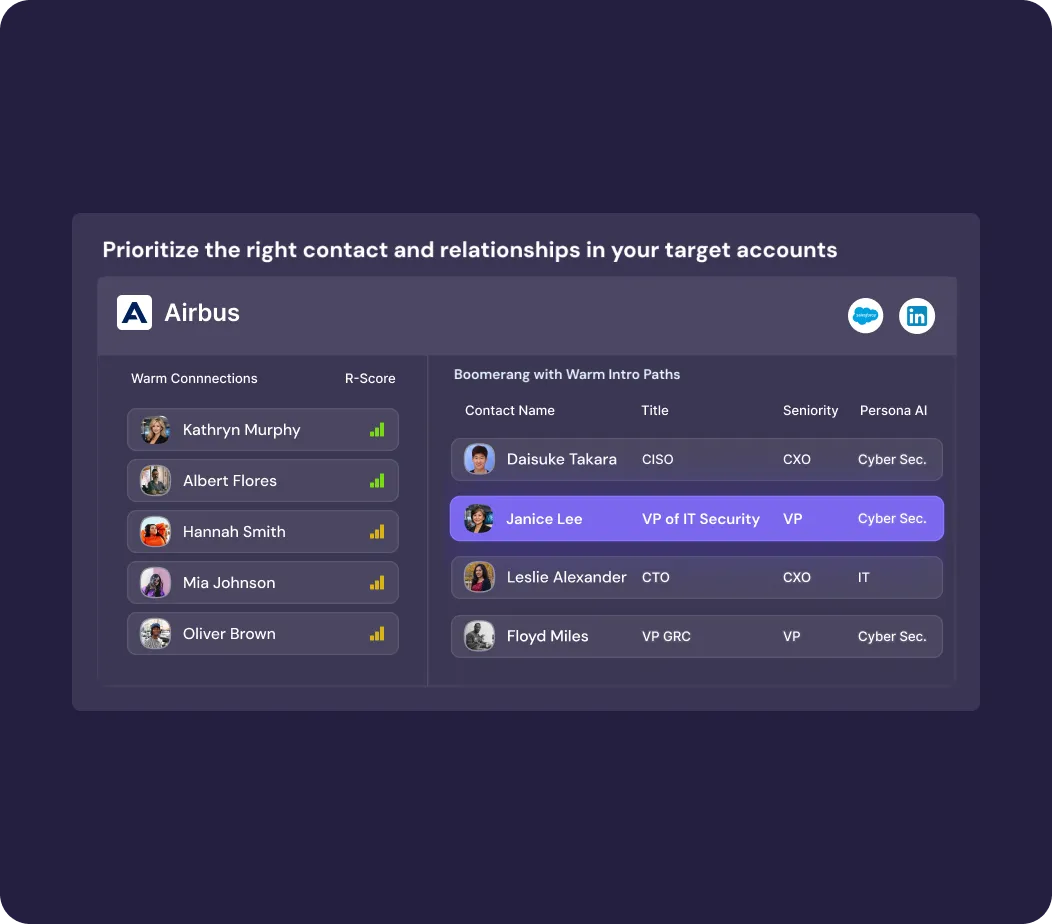
Josh: The hardest part is deciding who you activate and how. Let me show you. I type in a target account in Boomerang and see all the paths through our investors and advisors, with different signals: two people who sit on a board together, two people who overlapped at Salesforce over the last five years, or a strong first-degree connection to someone at our company who can broker the intro. Boomerang scores these from strong and likely on down. It isn't just connections and work overlaps; it's also things like two people who co-presented at an event in 2016. That was a long time ago, but if it's your only path, it's worth asking, "Do you still keep in touch?"
Activation is the easy part; surfacing is the hard part. Once it's surfaced, it's the rep's judgment to pick the best path. It also helps you multithread: I can see the CRO and CMO and the whole buying committee and the overlaps into each. So we use Boomerang not just to drive pipeline but to multithread into deals.
Shankar: I love that you're showing the product live. No better proof.
Josh: There are so many products these days where it's a Figma mockup or a bunch of people running prompts in the back end. This was delivering value from day one. It's one of the few products I've seen in the last few years that really moves the needle.
Shankar: Very kind words. I don't see any other questions. Josh, this has been phenomenal. I've learned a ton, and I'm sure the audience has too. You've been one of our earliest customers and helped shape the product, so thank you, and thank you for sharing your learnings.
Josh: And I'm now a connector in Boomerang, for Boomerang. If anyone listening is curious about the nitty-gritty of how I implemented this, shoot me a DM or add me on LinkedIn. I'm happy to get on a quick 15-minute call to show our approach. I love meeting people doing similar work and swapping ideas.
Shankar: We'll take you up on the offer of more prospects through you as a connector. Very meta. Thank you, Josh, and thank you everyone for attending. Hopefully we'll catch up again soon. Cheers.

✅ Customer Marketing & Advocacy Leaders
✅ Demand Generation & Growth Marketers
✅ Customer Success & Retention Teams
✅ RevOps & Sales Teams
🚀 Exclusive Insights – Learn from industry leaders shaping the future of customer marketing
📊 Proven Strategies – Actionable takeaways to implement immediately
💡 Real-World Case Studies – Discover what’s working in top B2B companies
📈 Revenue-Driven Approach – Focus on pipeline growth and customer expansion



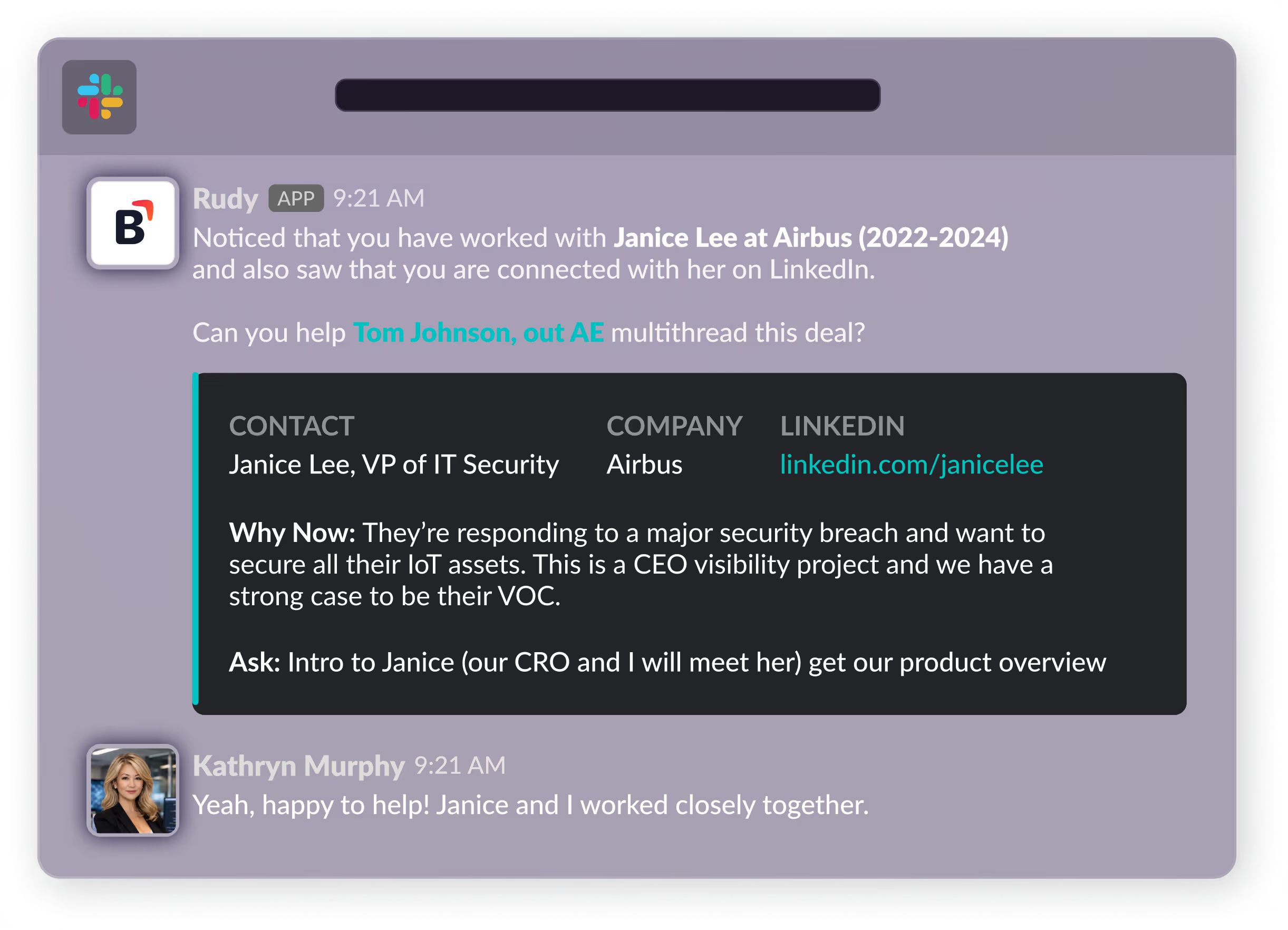

Rudy, our AI referral agent, finds the warm path, drafts the ask for the right person to send, and tracks it to the meeting.



