Multithreading Report 2026
Boomerang original research
Most of the people who decide your deal never meet you. What Armis, 1mind, Digideck, Storylane and the largest public deal datasets say about how AEs reach them.
The gap
Every AE knows the feeling. The champion is great, the calls go well, and the deal still stalls somewhere you can't see. That is because most of the buying committee never joins a call. They read what the champion forwards, ask the champion a question in a hallway, and decide.
We looked at what four Boomerang customers (Armis, 1mind, Digideck and Storylane) saw when they mapped their accounts, and at the largest public datasets on deals and buyers, to find out when AEs reach the rest of the committee, how, and what happens when they do. Four trends came back.
Trend #1
You meet roughly one in ten of the people who decide, and most AEs only start looking for the rest after the first meeting.
Gartner puts a B2B buying group at five to 16 people across as many as four functions. Gong's data shows that the deals that close have twice as many buyer contacts as the deals that don't.
So the committee is large, it decides without you, and the habit is to wait. By the time the first meeting has happened, the champion is already carrying your story into rooms you will never see.
Trend #2
Contact data decays faster than deals close. The people are still there. The records are not.
Plus primary buyers missing from some accounts entirely.
Most AEs build the committee from the CRM and a database export. Armis found that close to a third of the contacts it was targeting had left, and a quarter held the wrong titles. One account had no C-level or VP owner for information security at all. Its agents refreshed the full buying committee in 1,700 accounts and flagged 60,000 stale or misfit contacts.
The good news is on the other side of the same exercise. Once relationships were mapped, the team had about five warm contacts per account to work with.
Trend #3
Win rates climb as more of your own team joins the deal, and the biggest lift comes from your executives.
Multithreading is usually framed as reaching more people on the buyer's side. Gong's data says your side matters as much: engineer to engineer, executive to executive, customer to peer.
In deals over $50K, multithreading lifts win rates by an average of 130%. Executives are the least-used people in most deals and the ones linked to the biggest lift.
Trend #4
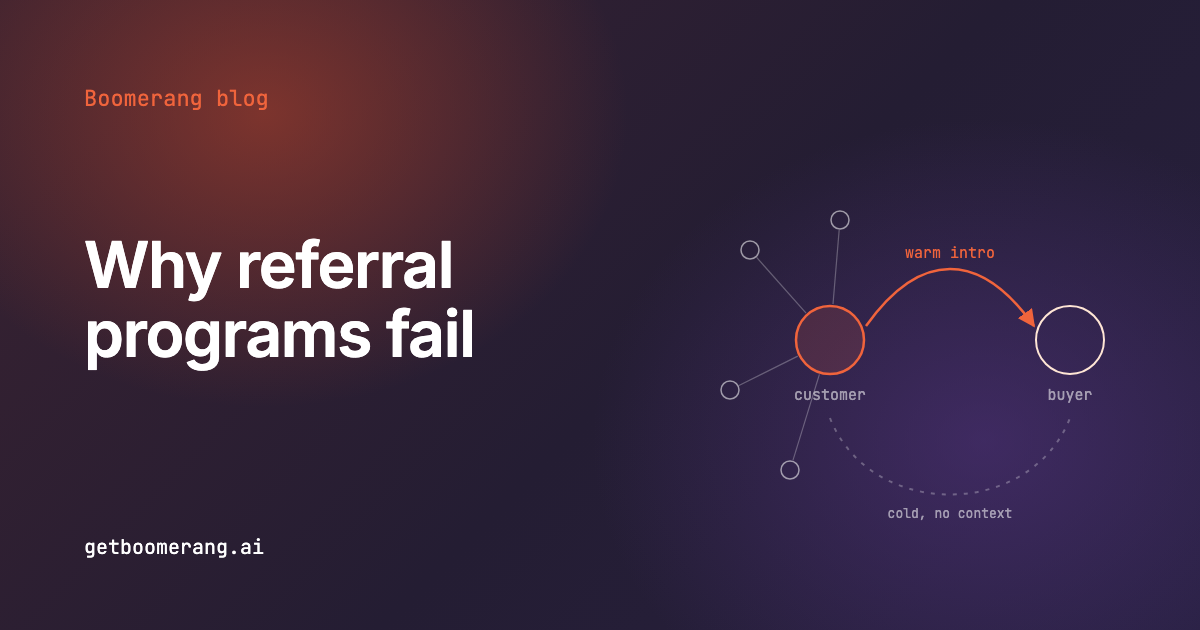
Executives ignore cold email. They answer people they know. Relationship-sourced deals qualify and close at a different rate.
C-level executives are 30.2% less likely to reply to cold email than other buyers. Reaching them through someone they already know is not a nice-to-have, it is the only reliable door.
LinkedIn found that sellers who beat quota generate 20% more meetings from warm introductions. Digideck saw it inside weeks: one rep, working customer relationships into related companies, opened three to four new opportunities while the rest of the team was at trade shows.
The takeaway
The committee is large and mostly invisible, the data you would use to reach it is stale, and the cold route to senior people is closed. The AEs who win map the committee with their champion early, and reach every gap through someone the buyer already trusts.
On the next first call, ask "if this goes well, who else will need to be comfortable with it?" and write the map together in the recap.
For every deal above your threshold, score each role from 0 to 4. Anything below 6 out of 16 is not a commit.
Search your executives, investors, customers and partners for who knows each missing person, and ask through whoever owns the relationship.
Get the full report
25 pages. Free. Your download opens right after you submit.
Thanks. Your copy is ready.
Download the PDFCustomer figures come from four published Boomerang case studies. Armis is a $400M ARR cybersecurity company (contact checks from a proof of concept, then one year in production). 1mind is a Series A AI company with 15 AEs (120 days of closed opportunities by pipeline source). Digideck is a sports-tech software company with three reps. Storylane is an early-stage product-led software company. Storylane's separate buyer research is quoted as a third-party source.
Third-party figures are quoted from the original publications. Studies use different samples and dates and are not directly comparable. Relative figures are reported as published; we do not report absolute conversion rates.